1. Driving Control (Base Actuation)

The robot's base is a differential drive system. To achieve smooth, human-like motion, we do not simply send "go" commands. Instead, we implemented a Closed-Loop Controller running at 20Hz.

This controller continuously compares the robot's current heading (from Odometry/TF) against the desired Bézier waypoint. It calculates error and outputs precise velocity commands (Twist messages) to the /cmd_vel topic. We also implemented a Low-Pass Filter on the angular velocity to prevent wheel slip and mechanical oscillation.

# From move_to_object.py: Control Loop

def control_loop(self):
    """Executes at 20Hz to drive the robot"""
    # 1. Get current pose from TF
    pose = self.get_current_pose()
    
    # 2. Calculate Heading Error to target waypoint
    angle_to_target = math.atan2(dy, dx)
    angle_error = self.normalize_angle(angle_to_target - pose.yaw)
    
    # 3. Apply Low-Pass Filter (Smooths the turn)
    raw_angular_vel = self.kp_angular * angle_error
    self.filtered_angular_vel = (self.alpha * raw_angular_vel) + ((1 - self.alpha) * self.filtered_angular_vel)
    
    # 4. Publish Velocity
    twist = Twist()
    twist.linear.x = linear_vel
    twist.angular.z = self.filtered_angular_vel
    self.cmd_vel_pub.publish(twist)

2. Arm Logic: The State Machine

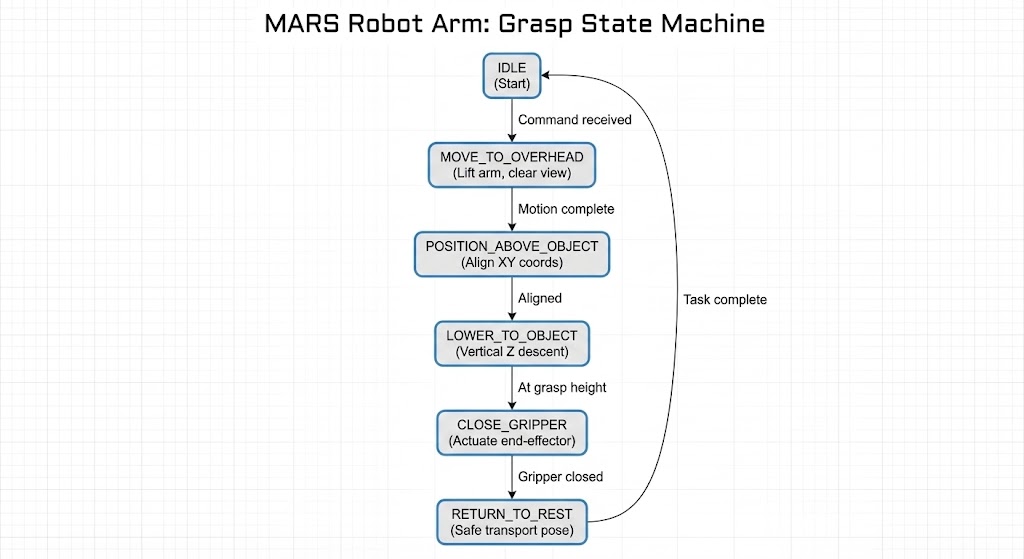
Unlike the base, the arm requires discrete logic states to operate safely. We cannot simply "move to the ball" because the arm might collide with the object or block the camera view. We implemented a Finite State Machine (FSM) to strictly enforce the sequence of operations.

Arm State Machine Logic

The system transitions through specific states: first moving to an Overhead position to verify the object location, then descending vertically to Grasp, and finally retracting to a Home pose.

# From arm_movement.py: State Machine Definitions

class GraspState(Enum):
    IDLE = 0
    MOVE_TO_OVERHEAD = 2       # Lift arm to clear camera view
    POSITION_ABOVE_OBJECT = 6  # Align XY coordinates
    LOWER_TO_OBJECT = 8        # Vertical Z descent
    CLOSE_GRIPPER = 10         # Actuate end-effector
    RETURN_TO_REST = 11        # Safe transport pose

def update_arm_state(self):
    """ Transitions states based on motion completion flags """
    if self.state == GraspState.MOVE_TO_OVERHEAD and self.motion_complete:
        self.state = GraspState.POSITION_ABOVE_OBJECT
        self.motion_complete = False

3. Actuating the Joints (Inverse Kinematics)

To move the arm to a specific 3D coordinate (x, y, z), we must calculate the required angles for all 5 joints. We use an Inverse Kinematics (IK) Solver that takes the target coordinate in the base frame and outputs the necessary joint configurations.

These joint targets are published to the /joint_states topic, which the lower-level hardware drivers use to move the servos.

# From arm_movement.py: Kinematics

def move_arm_to_coords(self, x, y, z):
    """Calculates joint angles for a target 3D point"""
    
    # 1. Transform Camera Detection -> Base Frame
    target_base = self.transform_camera_to_base(x, y, z)
    
    # 2. Solve IK
    joint_angles = self.ik_solver.calculate_ik(target_base.x, target_base.y, target_base.z)
    
    # 3. Publish to hardware
    msg = JointState()
    msg.position = joint_angles
    self.joint_pub.publish(msg)

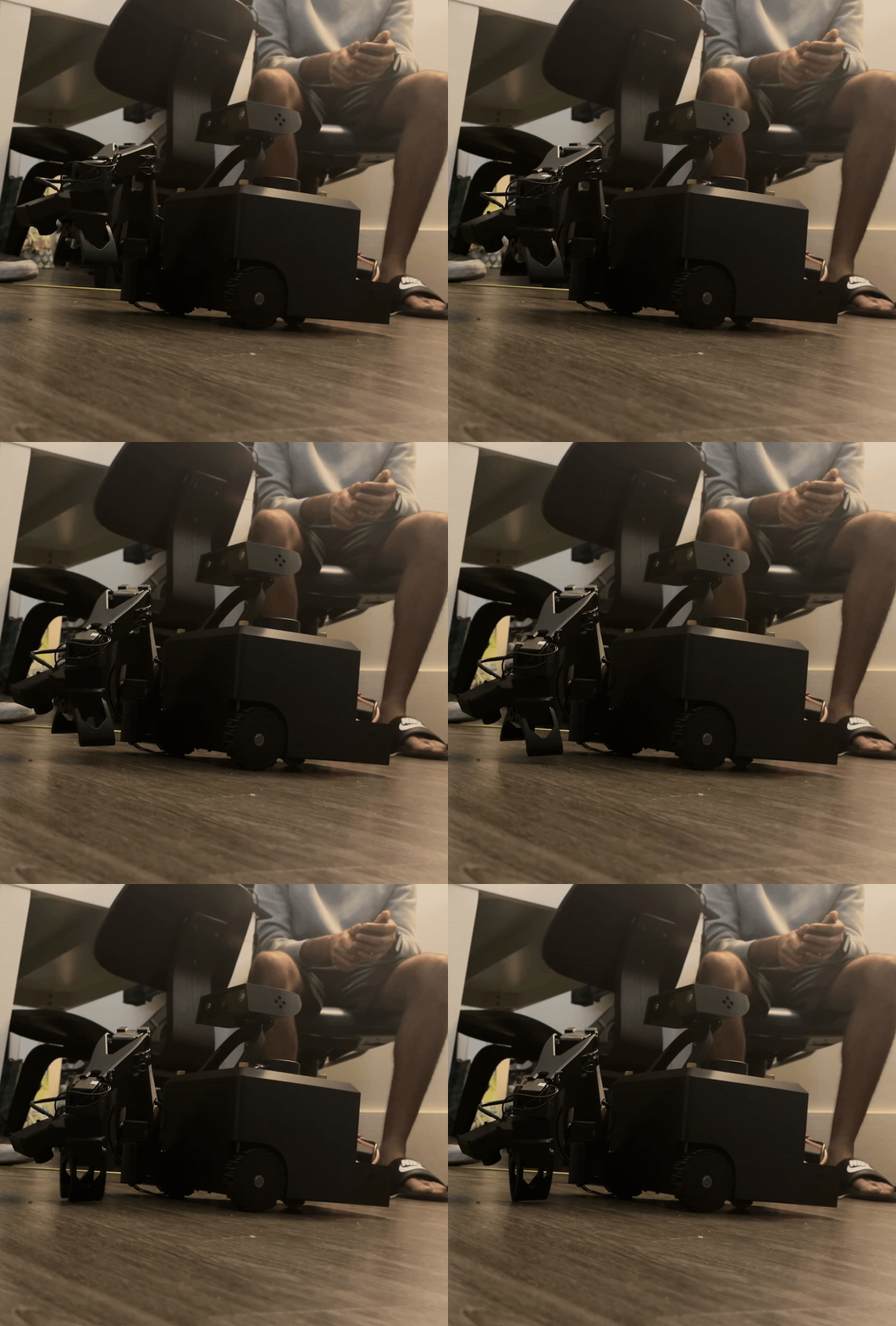
4. End-Effector (Gripper) Actuation

The final stage of actuation is physical interaction. The gripper is driven by a servo motor controlled via Pulse Width Modulation (PWM) signals. We determined specific duty cycles corresponding to the "Open" (7.5) and "Closed" (12.5) positions to ensure a firm grasp on the paper ball.

Gripper Closing Action
# From arm_movement.py: Servo Control

def activate_gripper(state):
    """Direct PWM control of the gripper servo"""
    if state == "OPEN":
        # Neutral position (0 degrees)
        pwm.set_duty_cycle(SERVO_PIN, 7.5) 
        
    elif state == "CLOSE":
        # 180 degree position (Fully clamped)
        pwm.set_duty_cycle(SERVO_PIN, 12.5) 
        
    # Block thread to ensure mechanical completion
    time.sleep(1.0)